
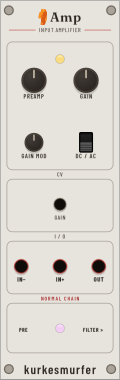
Amp
Stepped preamplification, differential input, AC coupling, and voltage-controlled gain.
VCV Rack 2 instrument family
Six modules for building lock-in-style patches.

Architecture
Homodyne turns the main parts of a lock-in amplifier into separate VCV modules. Use them together through the expander connection, or patch each one into other systems.
Testing status
The current VCV version passes its Apple Silicon test. Matching Intel macOS, Windows x64, and Linux x64 packages have been built and are ready for testing on those machines.
Module family
Stepped preamplification, differential input, AC coupling, and voltage-controlled gain.
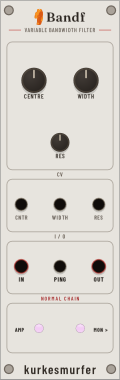
A pingable variable-bandwidth filter with centre, width, and resonance control.
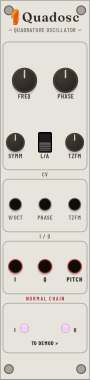
A through-zero quadrature oscillator with sine/cosine outputs and pitch tracking.
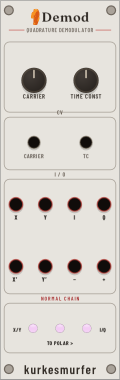
Quadrature multiplication, time-constant filtering, and sum/difference outputs.
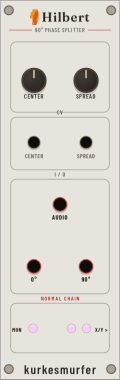
A wideband phase-splitting network with in-phase and quadrature outputs.
Converts I/Q signals into magnitude and phase control voltages.
Inspiration
Homodyne is inspired by the signal architecture of the Joranalogue Audio Design × Hainbach Collide 4 and by historical lock-in amplifiers. The software, DSP, panels, and six-module layout are independent work. It is not affiliated with or endorsed by Joranalogue Audio Design or Hainbach.